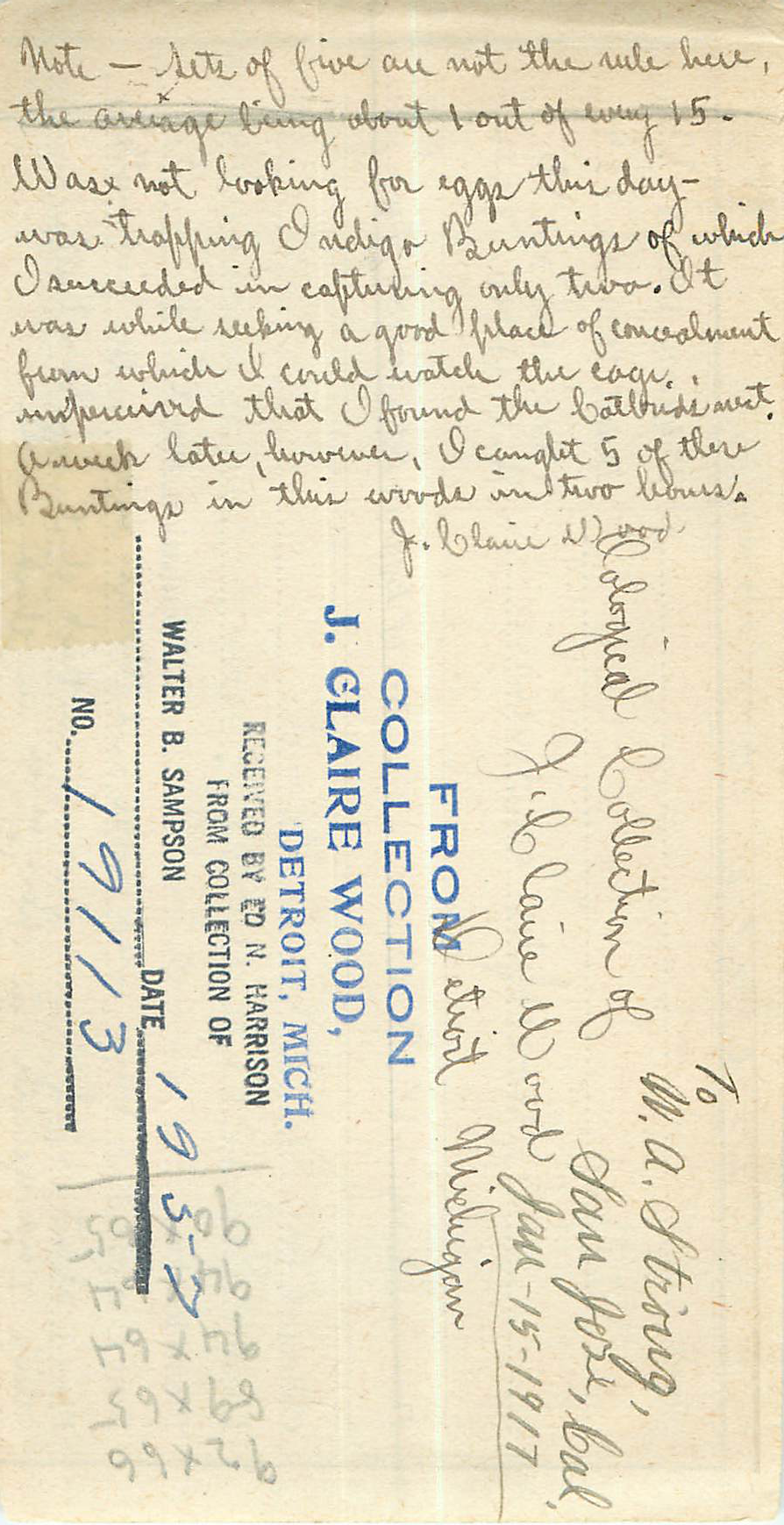

Field Notes · Catnum 19113 · score 4 — moderate uncertainty
Nest composed of: brush, weed stalks and twigs lined with fine rootlets. Placed: about 3 feet from ground in thick cluster of berry bushes amid thick 2nd growth in open piece in thick woods. Note - Sets of five are not the rule here, the average being about 1 out of every 15. I was not looking for eggs this day - was trapping Indigo Buntings of which I succeeded in capturing only two. It was while seeking a good place of concealment from which I could watch the cage, unperceived that I found the Catbird's nest. Several hours later, however, I caught 5 of the Buntings in this woods in two hours.
Metadata · Catnum 19113
Date21 May 1899
LocalityGreenfield Township, Wayne, Michigan, USA
CollectorWood, J. Claire
Eggs in Set5
Specimen TypeE
Incubationslight (transcribed as “about 1/4”)
Identificationpositive (transcribed as “Sure”)
Nest Supportthick cluster of berry bushes
Nest Materialsbrush, weed stalks, twigs
Nest Liningfine rootlets
Nest Settingthick 2nd growth in open piece in thick woods
Nest NotesSets of five are not the rule here, the average being about 1 out of every 15. Nest was found while seeking concealment to watch an Indigo Bunting cage trap.
HeaderFROM COLLECTION J. CLAIRE WOOD, DETROIT, MICH.
Further DetailsTo W. A. Strong, San Jose, Cal. Jan. 15, 1917 | 5-Jan
✦ Anecdote
This nest was discovered serendipitously while the collector was engaged in trapping Indigo Buntings, finding the catbird nest only while seeking a hiding spot to watch his bird trap.