
Field Notes · Catnum 240029 · score 24 — high uncertainty
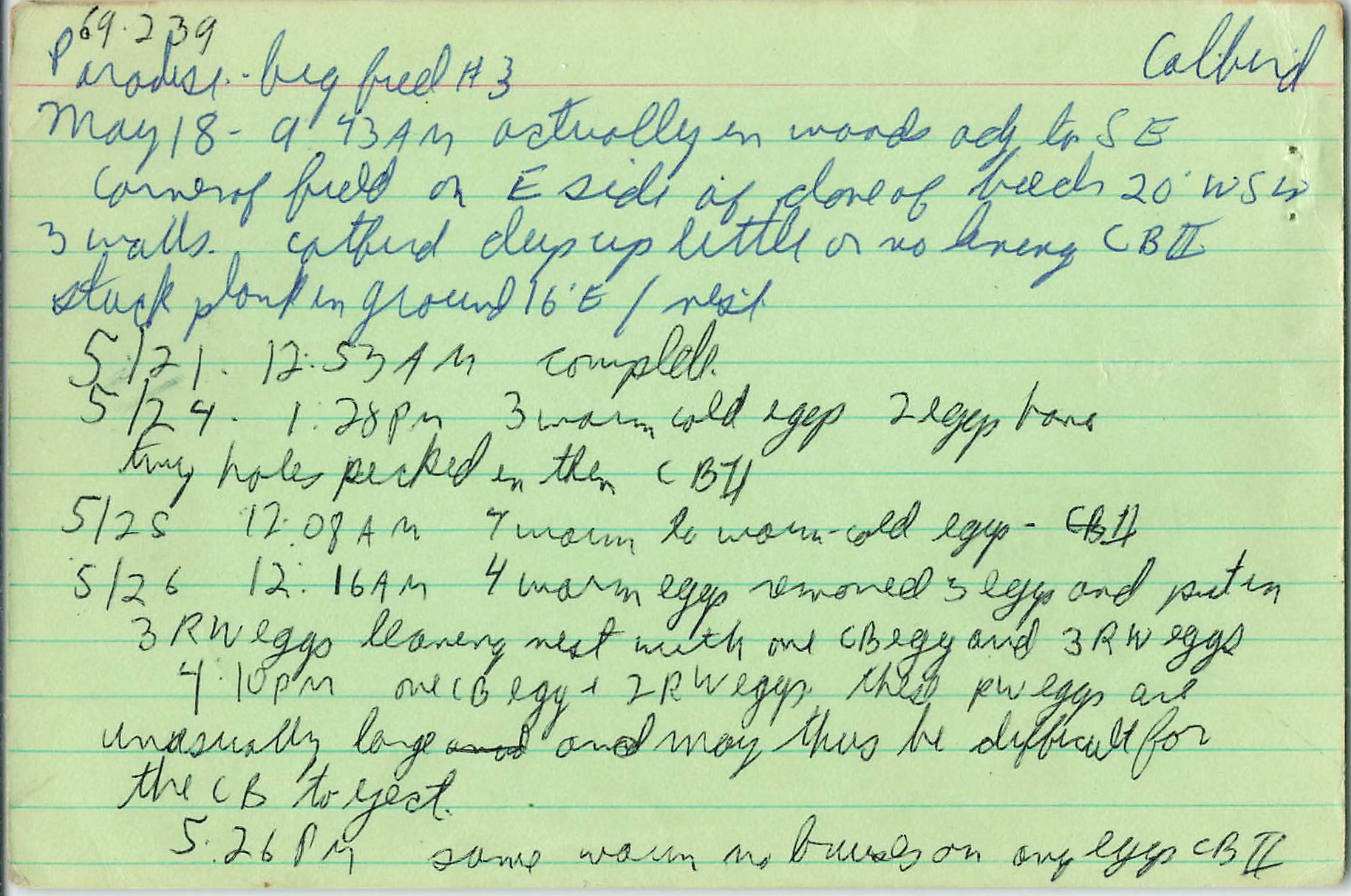
Parasitic - Begin feeding #3 May 18 - 9:43 AM actually in woods adjacent to SE corner of field on E side in clove of trees 20' W 5' 3 walls. Gathered clumps little or no lining. CBT stuck plank in ground 16' E of nest. 5/21 12:53 AM complete. 5/24 1:28 PM 3 warm cold eggs, 2 eggs have tiny holes pecked in them - CBT. 5/28 12:08 AM 7 warm to warm cold eggs - CBT. 5/26 12:16 AM 4 warm eggs removed 5 eggs and put in 3 RW eggs leaving nest with one CB egg and 3 RW eggs 4:10 PM one CB egg 1 RW egg. These RW eggs are unusually large and may thus be difficult for the CB to eject. 5:26 PM same warm no bruises on any egg CBT. 5/27 8:40 AM same warm CBT 6:00 PM one RW egg + CB egg warm to warm - old no bruises on the egg CBT. 5/28 10:27 AM same warm no bruises on the egg CBT. 5/29 9:78 AM only scattered egg cold. June 1 11:47 AM one scattered egg hole went out seems as if about only 2/3 of contents present.
Metadata · Catnum 240029
Date26 May 1969
LocalityNew Haven, Connecticut, USA
CollectorRothstein, Steve
Eggs in Set4
Specimen TypeE
Incubationfresh
Identificationunknown
Nest Height1.52 m (5 feet)
Nest Supportclove of trees
Nest Materialsgathered clumps
Nest Lininglittle or no lining
Nest Settingwoods adjacent to SE corner of field on E side
Nest NotesParasitic nest with Brown-headed Cowbird eggs. Initially found with 3 eggs, later had cowbird eggs added and removed experimentally. Nest monitored from May 18 through June 1. Some eggs had small holes pecked in them. Final observation showed scattered eggshells with partial contents remaining.
Further Details24.39 x 17.96 - 4 23.41 x 17.86 - 13 23.68 x 17.69 none of these eggs had any develop | 69-239
✦ Anecdote
This record documents an unusual experimental manipulation where cowbird eggs were artificially added and removed from a Gray Catbird nest, with detailed observations of the host's response to parasitic eggs of varying sizes.